
OEM vs OEE Car Glass in UAE : Which Is Better for Your Car in 2026 ?
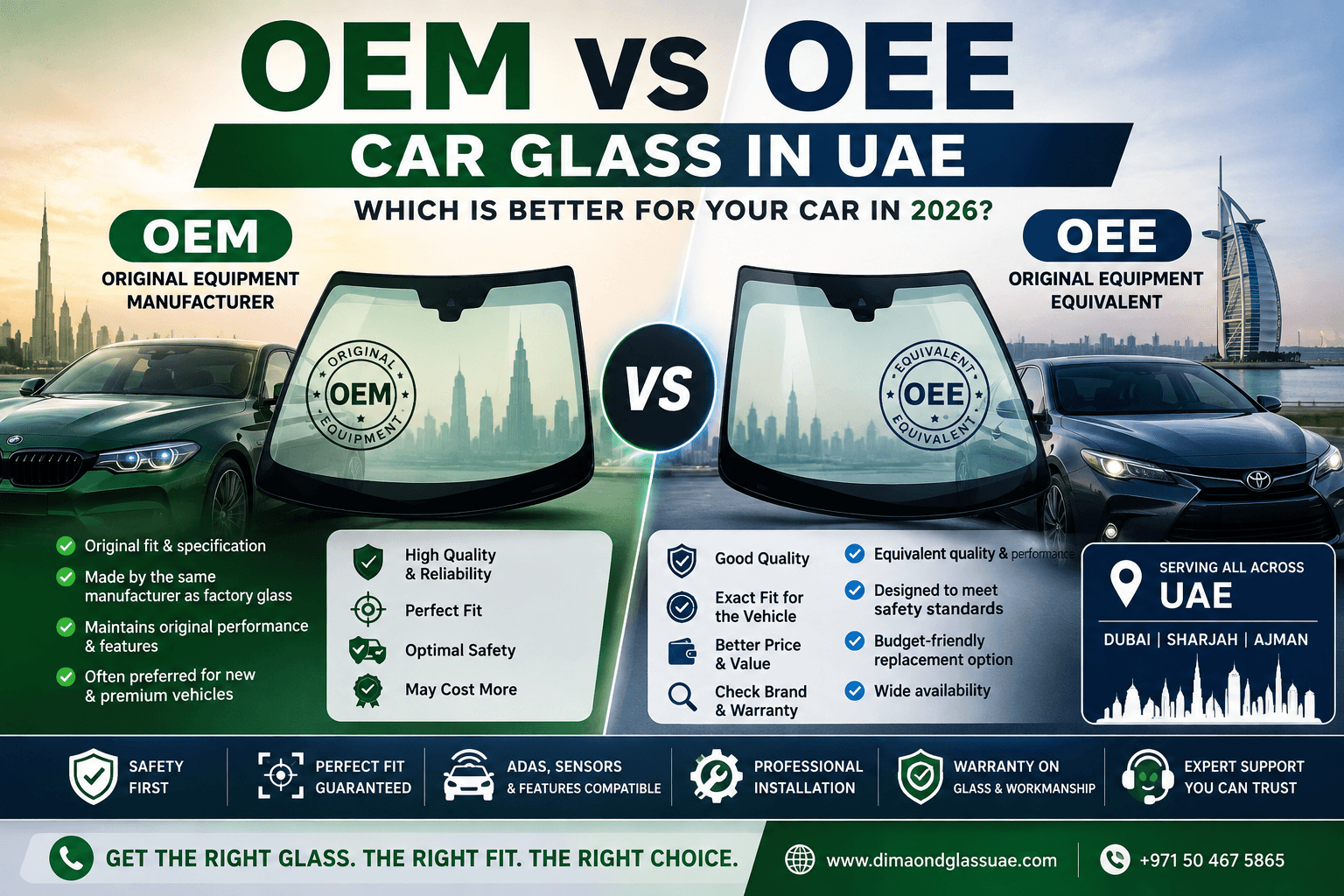
If your windshield, side window or rear glass is damaged, one of the first questions you may face is whether to choose OEM or OEE replacement glass.
For UAE drivers, the decision can be confusing. OEM glass is often associated with the vehicle’s original equipment, while OEE glass may offer a more economical replacement option. But price alone does not tell you whether a particular piece of automotive glass is suitable for your vehicle.
When comparing OEM vs OEE car glass UAE, you should consider the exact glass specification, vehicle compatibility, safety-glass construction, sensors and cameras, acoustic or solar-control features, installation quality and your budget.
This becomes particularly important on newer vehicles equipped with technologies such as:
- Forward-facing ADAS cameras
- Rain sensors
- Head-up displays (HUD)
- Acoustic glass
- Solar-control coatings
- Antennas
- Heating elements
- Special tint or shading
- Advanced mounting systems
The best replacement is therefore not automatically the most expensive option. It is the glass that correctly matches your vehicle and is installed according to the requirements of that application.
Quick Answer: OEM vs OEE Car Glass Which Should You Buy?
If you want the shortest answer:
Choose OEM glass when maintaining the closest available original-equipment specification or manufacturer-associated part is your priority, particularly when your vehicle has complex integrated windshield features and the cost is acceptable.
Consider quality OEE glass when a correctly specified equivalent replacement is available from a reputable source and you want to balance compatibility, performance and cost.
But do not choose either option from the label alone.
Before approving replacement glass, confirm:
- Is it correct for my exact make, model and year?
- Does it match the required safety-glass construction?
- Does it support my vehicle’s cameras or sensors?
- Is it compatible with HUD if my vehicle has one?
- Does it match acoustic or solar-control requirements where applicable?
- Is professional installation included?
- Will ADAS calibration be required after windshield replacement?
- What product and workmanship warranty applies?
Those questions are more useful than simply asking, “Is OEM better than OEE?”
What Does OEM Car Glass Mean?
OEM stands for Original Equipment Manufacturer. The Automotive Glass Safety Council’s terminology likewise defines OEM as “original equipment manufacturer.”
In practical terms, when customers ask for OEM car glass in Dubai, they are generally looking for glass associated with the vehicle’s original-equipment supply or specification.
Depending on the vehicle and replacement part, OEM glass may be attractive to owners who want:
- Original-equipment-associated specification
- Familiar branding or markings
- Close alignment with the vehicle’s factory configuration
- Compatibility with original integrated features
- An option preferred for a premium or relatively new vehicle
However, the term should not be treated as a substitute for checking the actual part.
Even when choosing OEM, the replacement still needs to be correct for the exact vehicle configuration.
What Does OEE Car Glass Mean?
OEE commonly refers to Original Equipment Equivalent glass.
It is generally used to describe replacement automotive glass intended to provide an equivalent application rather than necessarily carrying the same vehicle-manufacturer branding as an OEM part.
For UAE drivers, a suitable OEE option may be attractive because it can potentially provide:
- Lower replacement cost
- Greater availability for some vehicles
- Correct vehicle-specific fit when properly sourced
- An alternative to higher-priced OEM glass
But there is an important distinction:
Not every non-OEM windshield should automatically be treated as equal.
Quality, specifications and manufacturing can differ between products.
Instead of asking only:
“Is this OEE?”
also ask:
“Who manufactured it, what specification does it meet, and is this exact glass correct for my vehicle?”
That is a much stronger buying question.
OEM vs OEE Car Glass Comparison
| Factor | OEM Glass | OEE Glass |
|---|---|---|
| Original-equipment association | Yes | Equivalent replacement |
| Vehicle compatibility | Must be confirmed | Must be confirmed |
| Price | Often higher | Often more economical |
| Availability | Depends on vehicle | Can sometimes be easier to source |
| Manufacturer branding | May carry OE-related branding | Usually different branding |
| ADAS compatibility | Depends on exact part | Depends on exact part |
| HUD compatibility | Must be verified | Must be verified |
| Acoustic specification | Vehicle/part specific | Vehicle/part specific |
| Solar-control features | Vehicle/part specific | Vehicle/part specific |
| Installation quality | Critical | Critical |
| Best choice | Depends on vehicle and owner priorities | Depends on quality and exact specification |
OEM vs OEE is only one part of the decision..
Is OEE Glass Safe?
This question deserves a careful answer.
You should not assume that every OEE product is automatically good simply because someone calls it “equivalent.” Likewise, you should not assume that a non-OEM product is automatically unsafe merely because it does not carry the vehicle manufacturer’s branding.
For UAE applications, the relevant safety-glass specification and conformity matter.
UAE regulatory material specifically identifies motor-vehicle laminated safety glass and references UAE/GSO standards for laminated safety glass as well as mechanical and optical testing.
UAE tariff classifications also separately recognize tempered and laminated safety glass intended for incorporation into vehicles.
Therefore, when buying replacement glass, focus on whether the product is correctly specified and suitable for the vehicle—not merely whether a seller describes it as OEM or OEE.
Is OEM Glass Always Better Than OEE?
Not necessarily in every practical situation.
OEM may be the preferred option for some owners, especially when:
- The vehicle is new
- Maintaining original specification is a priority
- The windshield has complex technology
- The owner wants original-equipment-associated glass
- Insurance or another requirement influences part selection
But a correctly specified quality equivalent may be a sensible option for another driver.
For example, the owner of an older everyday vehicle may prioritize:
- Safety
- Correct fit
- Reliable installation
- Availability
- Reasonable replacement cost
rather than paying more solely for a particular logo.
This is why the answer depends on the vehicle + glass + features + budget + installation, not one label.
Is OEM Glass Safer Than OEE?
You should avoid judging automotive-glass safety solely by the OEM/OEE label.
Safety depends on factors including:
- Correct glass construction
- Product specification
- Correct vehicle application
- Proper installation
- Correct adhesive system where applicable
- Proper handling
- Compatibility with safety technology
For windshields in particular, installation procedures are important because automotive glazing contributes to the vehicle’s safety system. Industry replacement standards emphasize appropriate products, procedures and installation practices.
So the better question is:
“Is this replacement glass properly specified and professionally installed for my vehicle?”
Why Is OEM Car Glass Usually More Expensive?
OEM glass can cost more for several reasons.
These may include:
- Original-equipment supply chain
- Branding
- Vehicle-specific manufacturing
- Distribution
- Lower availability
- Integrated technologies
- Premium vehicle applications
However, not every price difference is caused simply by the OEM name.
A modern windshield itself can be significantly more complex than basic automotive glass.
Why Modern Windshields Cost More
Older vehicles may have relatively straightforward windshields.
Modern cars can integrate considerably more technology.
Depending on the model, the windshield may accommodate:
ADAS Camera
Forward-facing cameras can support systems such as:
- Lane departure warning
- Lane keeping functions
- Forward collision-related functions
- Traffic-sign recognition
- Automatic high-beam functions
The exact systems vary by vehicle.
Rain Sensor
A rain sensor can help the vehicle automatically control windshield wipers.
Head-Up Display
HUD-compatible windshields can require specific optical characteristics so information is displayed correctly.
Acoustic Layer
Acoustic laminated glass can help reduce certain exterior noise entering the cabin.
Solar-Control Features
Some glass incorporates features intended to manage solar energy or cabin heat.
Antenna or Electronics
Certain vehicles incorporate antennas or other electrical elements into automotive glass.
Because of these variations, ordering glass based only on vehicle model name can be risky.
Why Your VIN Can Matter When Ordering Car Glass
Your VIN or chassis number can be extremely useful when identifying replacement glass.
A single vehicle model may have multiple windshield variants.
For example, the same model and year might be available with:
- Standard windshield
- Camera windshield
- Rain-sensor windshield
- HUD windshield
- Acoustic windshield
- Different tint/shade specification
- Different market specification
A customer might say:
“I need a 2022 Toyota windshield.”
But that may not provide enough information.
A better request includes:
Make + model + year + VIN/chassis number + photos of the existing glass/sensors.
This can help the glass provider identify the correct specification before installation.
How to Read the Markings on Your Existing Car Glass
Automotive glass normally carries markings near a corner of the panel.
Depending on the product, these markings may provide information relating to:
- Manufacturer
- Safety certification
- Glass type
- Homologation/approval
- Production information
- Other specification codes
Do not worry if you cannot understand every symbol.
Take a clear close-up photograph of the existing glass markings and send it when requesting a quote.
For UAE customers, this can be particularly useful when a vehicle has several glass variants.
Windshield vs Side Window vs Rear Glass: OEM/OEE Choice Is Different
Not all automotive glass performs the same job.
Windshield
The windshield generally deserves the greatest attention because it may integrate:
- Laminated safety construction
- ADAS camera mounting
- HUD
- Rain sensors
- Acoustic layers
- Solar features
- Other electronics
UAE standards specifically address motor-vehicle laminated safety glass.
Side Door Glass
Side windows may use tempered or, on some vehicles, laminated construction.
When replacing side glass, verify:
- Front or rear door
- Left or right side
- Tempered or laminated specification
- Tint
- Acoustic properties where applicable
- Mounting design
The window regulator and channels should also operate correctly.
Rear Glass
Rear automotive glass may include features such as:
- Heating/defroster elements
- Antenna functions
- Tint
- Vehicle-specific connectors
Again, correct part identification matters more than simply ordering “rear glass.”
Tempered vs Laminated Glass: Don’t Confuse This With OEM vs OEE
This is an important distinction.
OEM/OEE describes the replacement sourcing/specification category.
Tempered/laminated describes glass construction.
They are not competing terms.
You can potentially encounter:
- OEM laminated glass
- Equivalent laminated glass
- OEM tempered glass
- Equivalent tempered glass
UAE classifications explicitly distinguish tempered safety glass from laminated safety glass for vehicle applications.
What Is Laminated Car Glass?
Laminated safety glass uses multiple layers with an interlayer.
This construction helps hold glass together when damaged rather than allowing it to behave like conventional ordinary glass.
Windshields commonly use laminated safety-glass construction.
The UAE’s automotive spare-parts framework references the UAE.S GSO 1677/2003 Motor Vehicles Laminated Safety Glass standard, alongside mechanical and optical test standards.
What Is Tempered Car Glass?
Tempered safety glass is heat-treated to alter its breaking characteristics.
It is commonly found in vehicle side and other glazing applications, although the exact glass type depends on the vehicle.
When severely broken, tempered glass typically fragments rather than behaving like ordinary household plate glass.
Once a tempered side window has shattered, replacement is generally the practical solution.
OEM vs OEE for Toyota, Nissan and Other Common UAE Cars
For commonly driven vehicles in the UAE, owners may have several replacement options depending on model and availability.
For vehicles such as:
- Toyota
- Nissan
- Honda
- Hyundai
- Kia
- Mitsubishi
- Mazda
the decision should still start with identifying the exact glass.
A driver with a straightforward older vehicle may find a suitable equivalent option attractive from a cost perspective.
A newer vehicle with a camera, HUD or other integrated windshield technology may require more careful specification matching.
Do not make the decision based solely on the brand of the car.
What About BMW, Mercedes Benz Audi and Lexus?
Premium vehicles can require more attention because glass may incorporate additional comfort or driver-assistance technology.
Depending on the exact model and trim, this may include:
- Acoustic glass
- HUD compatibility
- Advanced camera brackets
- Solar coatings
- Rain/light sensor areas
- Specialized tint
- Laminated side windows
If you drive a premium vehicle in Dubai or elsewhere in the UAE, ask the supplier to identify the glass by VIN and equipment specification, rather than simply saying:
“Give me a BMW windshield.”
Different variants can look almost identical while having important functional differences.
OEM vs OEE for ADAS-Equipped Vehicles
This is where the decision becomes more technical.
Many newer vehicles use a forward-facing camera mounted around the upper windshield area.
If the windshield is replaced, the replacement must be appropriate for that application.
Depending on the vehicle manufacturer and system, calibration may also be required after windshield replacement.
The important questions become:
- Is this windshield correct for the camera system?
- Is the camera bracket correct?
- Does the glass meet the required optical characteristics?
- Does the vehicle require calibration?
- Who will perform the calibration?
- Is calibration included in the quotation?
Choosing an inexpensive windshield but ignoring these questions can be a false economy.
What Is ADAS Calibration?
ADAS stands for Advanced Driver Assistance Systems.
Some driver-assistance systems use cameras or sensors whose operation depends on their position and view through the windshield.
After relevant windshield work, certain vehicles may require calibration according to manufacturer procedures.
Calibration requirements vary between manufacturers and models.
Therefore, do not accept a blanket statement such as:
“Every car needs calibration.”
or:
“No car needs calibration.”
Ask specifically about your vehicle.
OEM vs OEE for Head-Up Display Windshields
A HUD projects information into the driver’s viewing area.
A windshield designed for HUD applications can have specific optical requirements.
Using glass that is not intended for the vehicle’s HUD system may potentially result in poor image quality, such as distortion or duplicated-looking projection.
If your vehicle has HUD, tell the glass provider before requesting a quote.
Ask explicitly:
“Is this replacement windshield HUD-compatible for my exact vehicle?”
Do not assume all windshields for the same model support HUD.
What About Acoustic Glass?
Some vehicles use acoustic laminated glazing to help reduce cabin noise.
If your existing windshield or side glass has an acoustic specification, replacing it with a different specification may affect the characteristics you were accustomed to.
Before choosing a cheaper alternative, ask whether it matches the acoustic requirements of the original application.
This is especially relevant for luxury and premium vehicles where cabin noise reduction is an important feature.
Does UAE Heat Make Glass Specification More Important?
The UAE’s climate makes correct automotive-glass selection and installation particularly relevant.
Vehicles in Dubai, Sharjah, Ajman and other Emirates regularly experience:
- Strong sunlight
- High ambient temperatures
- Dust and sand
- Significant air-conditioning use
However, avoid assuming that “UAE glass” is automatically a unique type of windshield for every vehicle.
What matters is obtaining the correct glass for the specific vehicle and market specification and having it installed properly.
Does More Expensive Glass Automatically Mean Better Glass?
No.
Price can be influenced by:
- Manufacturer
- Branding
- Vehicle rarity
- Supply
- Features
- Technology
- Logistics
- Dealer pricing
A higher price alone does not prove that one glass option is automatically safer or better suited to your vehicle.
Likewise, choosing the cheapest available option without verifying specification is not sensible either.
The goal should be correct value, not simply lowest price or highest price.
7 Things to Check Before Buying OEM or OEE Glass in UAE
Before approving your replacement, use this checklist:
1. Confirm Exact Vehicle
Provide make, model, year and VIN where useful.
2. Confirm Glass Location
Specify:
- Front windshield
- Front door
- Rear door
- Rear windshield
- Quarter glass
- Sunroof
3. Confirm Glass Construction
Ask whether the required glass is laminated or tempered.
4. Check Integrated Technology
Tell the installer about:
- ADAS camera
- Rain sensor
- HUD
- Heating
- Antenna
- Acoustic glass
5. Ask What Brand You Are Getting
Don’t accept only the word “OEE.”
Ask for the actual manufacturer/brand where available.
6. Ask About Installation
Correct installation is essential regardless of the glass brand.
7. Ask About Warranty
Understand what is covered by:
- Glass/product warranty
- Installation/workmanship warranty
and what is excluded.
Questions to Ask an Auto Glass Shop Before Paying
Save this list on your phone and use it when requesting quotations:
Is this OEM or OEE glass?
What is the glass manufacturer’s name?
Is it correct for my VIN?
Does it support my rain sensor?
Is it compatible with my ADAS camera?
Does it support HUD?
Is it acoustic glass if my original was acoustic?
Is installation included in the quote?
Does my vehicle require calibration?
Is calibration included?
What warranty do I receive?
These questions make it much easier to compare two quotations fairly.
A AED price difference means very little if one quotation includes the correct feature-compatible glass and required services while the other does not.
Red Flags When Buying Replacement Car Glass
Be cautious if a seller:
- Cannot identify the glass manufacturer
- Does not ask for your exact vehicle details
- Ignores cameras or sensors
- Claims one windshield fits every trim
- Cannot explain whether the glass supports HUD
- Does not distinguish laminated and tempered glass
- Promises that every OEE product is identical to OEM
- Says installation quality does not matter
- Gives no information about warranty
- Selects glass solely from a photograph of the car
A professional quotation should be based on enough information to identify the required part.
Is UAE Product Conformity Relevant?
Yes, product conformity is part of the broader UAE regulatory environment. The Ministry of Industry and Advanced Technology describes its conformity-certificate service as confirming that regulated products comply with standards approved in the UAE, and its public conformity data includes laminated safety glass among product types.
For an ordinary customer, however, you do not need to become a standards expert.
Your practical job is simpler:
Ask what glass you are receiving, confirm that it is suitable for your exact vehicle, and use a competent installer.
Which glass should you actually choose for your car in the UAE?
There is no single answer that works for every vehicle. A basic side window on an older daily-use car presents a very different decision from a windshield on a newer luxury vehicle equipped with a head-up display, acoustic glazing and an ADAS camera.
The right approach is to match the replacement to the vehicle, original glass specification, installed technology, condition of the car, budget and quality of installation.
Below is a practical decision guide for drivers in Dubai, Sharjah, Ajman and across the UAE.
Which Should You Choose: OEM or OEE Car Glass?
Use this quick decision table before getting into the details.
| Your Situation | Option to Consider | What Matters Most |
|---|---|---|
| New vehicle | OEM or correctly specified high-quality equivalent | Exact specification |
| Older daily-use vehicle | Quality OEE may be practical | Fit, safety specification and value |
| Luxury vehicle | OEM or verified equivalent | Features and optical quality |
| Vehicle with HUD | Exact HUD-compatible glass | Optical compatibility |
| Vehicle with ADAS camera | Correct camera-compatible windshield | Specification + calibration requirements |
| Basic shattered door glass | Correct quality replacement | Fit and window operation |
| Heated rear glass | Correct feature-compatible replacement | Heating/connectors |
| Acoustic glazing | Matching acoustic specification | Cabin comfort |
| Insurance claim | Depends on policy approval | Policy terms and approved parts |
| Limited OEM availability | Suitable verified equivalent | Correct specification and manufacturer |
This table is guidance rather than a universal rule. The exact replacement should still be verified for your particular vehicle.
When Does OEM Car Glass Make More Sense?
OEM glass can be worth considering when maintaining the closest possible relationship with the vehicle’s original equipment is important to you.
It may make particular sense in the following situations.
1. Your Vehicle Is New
Owners of newer cars often prefer to keep components as close to the original configuration as reasonably possible.
This can be particularly important if the windshield includes several integrated technologies.
2. Your Vehicle Has a Head-Up Display
If your vehicle projects speed, navigation or other information onto the windshield, the glass needs to be suitable for that system.
Do not choose a replacement solely because it physically fits the opening.
Ask:
“Is this exact windshield compatible with my vehicle’s HUD?”
3. Your Windshield Supports ADAS
Vehicles equipped with forward-facing cameras require extra attention during windshield replacement.
Correct glass selection matters, but so does determining whether the vehicle manufacturer requires camera calibration after replacement.
OEM may be preferred by some owners in these situations, although the key requirement remains correct compatibility and proper procedures.
4. You Want to Preserve the Original Specification
Some owners simply prefer original-equipment-associated components, especially on:
- Premium cars
- New vehicles
- Collector vehicles
- High-value vehicles
- Cars they intend to keep in original condition
In such cases, the additional cost may be worthwhile to the owner.
When Can OEE Car Glass Be a Good Choice?
A quality, correctly specified OEE replacement can be a practical alternative when OEM is unnecessary, unavailable or significantly more expensive.
1. Your Car Is an Older Daily Driver
Suppose you own an older Toyota, Nissan, Honda, Hyundai, Kia or Mitsubishi used for everyday commuting.
If a reputable equivalent replacement:
- Fits correctly
- Matches the required construction
- Supports the vehicle’s features
- Comes from a credible manufacturer
- Is professionally installed
then paying substantially more purely for original branding may not always provide enough additional value for that particular owner.
2. OEM Glass Is Difficult to Source
Some glass variants may not be immediately available in the UAE.
Waiting for an OEM part can be inconvenient if the vehicle cannot be safely or securely used.
A suitable equivalent may therefore be worth considering if it can be properly verified.
3. You Are Replacing Basic Door Glass
A straightforward tempered door window without complex features may present a simpler decision than a technology-heavy windshield.
That does not mean any piece of glass will work.
You still need the correct:
- Door
- Side
- Shape
- Thickness/specification
- Mounting arrangement
- Tint
- Glass construction
But the benefits of paying an OEM premium may be less important to some owners in this situation.
OEM vs OEE: Which Is Better for a Windshield?
For windshield replacement, you should be more careful than with many basic side-window applications.
Modern windshields can interact with vehicle systems and may include specialized properties.
Before choosing either OEM or OEE, determine whether your original windshield has:
- ADAS camera
- Rain sensor
- Light sensor
- HUD
- Acoustic layer
- Solar-control coating
- Antenna
- Heated area
- Special camera bracket
- Specific tint or shade
If the OEE windshield correctly supports all required features and is appropriate for the vehicle, it may be an option.
If compatibility cannot be confidently established, choosing purely on the lowest price is risky.
OEM vs OEE for Side Door Glass
Side door glass is often less complicated than a modern windshield, but there are still exceptions.
Some premium vehicles use:
- Laminated side glass
- Acoustic side glass
- Factory tint
- Frameless windows
- Special coatings
A frameless coupe window, for example, may require careful positioning because the glass needs to align correctly with the roof seal and surrounding body.
For ordinary side-window replacement, also inspect the:
- Window regulator
- Motor
- Run channel
- Weather seals
- Glass mounting points
If the old glass shattered, fragments can remain inside the door.
Replacing the glass without checking the mechanism can leave the customer with rattling, slow movement or alignment problems.
OEM vs OEE for Rear Glass
Rear glass should also be identified by specification rather than appearance alone.
Depending on the vehicle, rear glass can incorporate:
- Defroster/heating lines
- Antenna elements
- Tint
- Connectors
- Wiper openings
- Spoiler-related fittings
- Other vehicle-specific features
A replacement may physically look similar while differing in functionality.
Before installation, confirm that all required electrical features are supported.
What About Quarter Glass?
Quarter glass may look simple because it is usually smaller, but fitment can be vehicle-specific.
The correct replacement should match:
- Vehicle body style
- Left or right side
- Position
- Tint
- Mounting arrangement
- Surrounding trim
For fixed quarter glass, sealing is particularly important because poor installation may contribute to water leakage or wind noise.
Does OEM vs OEE Affect Car Glass Replacement Cost in UAE?
Yes, but it is only one factor.
The final price of car glass replacement in UAE can depend on:
- Make and model
- Model year
- Exact glass position
- OEM or OEE selection
- Manufacturer
- Availability
- Glass size
- Laminated or tempered construction
- HUD compatibility
- ADAS camera requirements
- Acoustic specification
- Solar-control features
- Heating elements
- Antennas
- Installation complexity
- Mobile service requirements
- Calibration, where applicable
For this reason, giving one universal price for every Toyota, Nissan, BMW or Mercedes windshield would be misleading.
A vehicle-specific quotation is much more useful.
Why Two Quotes for the Same Car Can Be Very Different
Imagine you receive two quotations:
Quote A: AED X
Quote B: AED Y
Choosing the lower number without comparing what is included may be a mistake.
One quotation might include:
- Correct feature-compatible windshield
- Installation
- New required consumables
- Sensor handling
- Broken-glass cleanup
- Workmanship warranty
while another may cover only the basic glass and installation.
Before comparing prices, ask both providers to clarify exactly what you are receiving.
What Information Should You Send for an Accurate UAE Quote?
Instead of messaging:
“How much BMW glass?”
send complete information.
Recommended Quote Checklist
Provide:
Vehicle make: Toyota
Model: Camry
Year: 2022
Glass: Front windshield
VIN/chassis: If requested
Location: Dubai
Damage: Crack / shattered / impact damage
Features: Camera, HUD, rain sensor, etc.
Photos: Full glass + close-up of markings/sensor area
For door glass, also state:
Front or rear + left or right.
This reduces the risk of quoting the wrong part.
Should You Send the VIN/Chassis Number?
When multiple glass variants exist, the VIN can help with correct identification.
This is especially useful for vehicles with different trim levels or technology packages.
If you are unsure about your windshield features, also send photographs of:
- The full windshield
- Area around the rear-view mirror
- Glass markings in the corner
- Damaged area
A professional glass provider can use these details to narrow down the correct replacement.
What If You Don’t Know Whether Your Glass Is OEM?
Check the markings printed or etched near a corner of the glass.
You may find information relating to:
- Glass manufacturer
- Approval markings
- Glass construction
- Production codes
- Other specifications
Take a clear photograph rather than trying to interpret every code yourself.
The glass supplier can inspect the markings alongside your vehicle information.
OEM vs OEE and Car Insurance in UAE
If the damage may be covered by insurance, check your policy before authorizing replacement.
Do not assume that every policy automatically pays for OEM glass.
Coverage can vary depending on:
- Insurance provider
- Policy type
- Glass coverage
- Accident circumstances
- Excess/deductible
- Approved repair network
- Parts conditions
- Claim approval
Ask your insurer specifically:
“Does my policy cover this glass damage?”
and:
“If the claim is approved, does the policy allow OEM glass, equivalent glass or an insurer-approved replacement?”
Your policy documents and insurer should be the final authority for your individual claim.
Should You Replace Glass Through Insurance or Pay Yourself?
Compare both options.
If the replacement is relatively inexpensive and the insurance excess is significant, a direct payment may sometimes be simpler.
For an expensive technology-equipped windshield, insurance coverage may be more valuable.
But this depends entirely on your policy.
Before making a claim, understand:
- Excess amount
- Claim process
- Approved repairers
- Glass specification allowed
- Calibration coverage
- Required documents
ADAS Calibration After Windshield Replacement
For vehicles equipped with camera-based driver-assistance technology, this is one of the most important questions to ask.
Some vehicles may require calibration after windshield replacement according to manufacturer procedures.
Calibration may be:
Static Calibration
Performed using specified targets/equipment while the vehicle is stationary.
Dynamic Calibration
May involve driving the vehicle under specified conditions.
Combination
Some systems may require more than one procedure.
The requirement depends on the particular manufacturer, model and system.
Do not assume calibration is included automatically in a windshield quote.
Ask before approving the job.
Can You Drive Immediately After Windshield Replacement?
For bonded windshields, the adhesive system needs sufficient time before the vehicle can safely be driven.
The appropriate safe drive-away time depends on the adhesive/product system and installation conditions.
Therefore, do not rely on a universal statement such as:
“Every windshield is ready in 30 minutes.”
Follow the installer’s stated safe drive-away instructions for the actual adhesive used.
This is one area where rushing to save time is not worthwhile.
What Should You Check After Car Glass Replacement?
Before leaving the workshop or after a mobile installation, inspect the work.
For a Windshield
Check:
- Glass appears correctly positioned
- Trim looks properly fitted
- No obvious adhesive contamination
- Rain sensor functions where applicable
- Camera-related procedures have been addressed
- No new obvious wind noise
- No visible water leakage
- Rear-view mirror and associated components are correctly fitted
For Door Glass
Operate the window several times.
It should:
- Move smoothly
- Close fully
- Sit correctly in the upper channel
- Not produce abnormal grinding
- Not tilt excessively
- Not create new rattling
For Rear Glass
Where applicable, check:
- Heating connections
- Trim
- Wiper fitment
- Electrical connections
- Sealing
If something appears wrong, report it promptly.
What Causes Wind Noise After Replacement?
New wind noise does not automatically mean the glass itself is poor quality.
Possible causes include:
- Incorrect alignment
- Weather-seal position
- Trim fitment
- Door-glass adjustment
- Frameless-window positioning
- Installation issue
This is why installation quality is part of the OEM vs OEE decision.
Premium glass installed poorly can still produce a poor result.
What Causes Water Leakage After Replacement?
Potential causes may include:
- Sealing problem
- Adhesive application issue
- Damaged surrounding components
- Incorrect fit
- Drainage-related issues
If water appears after replacement, have the installation inspected rather than trying to seal random areas yourself.
Should You Choose the Cheapest Car Glass in Dubai?
Price matters, but the cheapest quotation should not automatically win.
Before selecting a low-price option, determine:
- Who made the glass?
- Is it correct for your vehicle?
- What features does it support?
- What does the quote include?
- Who installs it?
- Is calibration required?
- What warranty is provided?
A cheaper correctly specified replacement can represent good value.
A cheaper incorrectly specified replacement does not.
Should You Automatically Buy the Most Expensive OEM Glass?
No.
The opposite assumption is also incorrect.
Paying more does not remove the need to verify:
- Part specification
- Vehicle compatibility
- Installation
- Technology support
- Calibration requirements
For some vehicles, OEM may be the owner’s preferred solution.
For others, a reputable equivalent can provide a better balance between requirements and budget.
Make the decision based on evidence, not price psychology.
Practical UAE Decision Examples
Here are several realistic examples to make the decision easier.
Scenario 1: Older Toyota Corolla With Broken Door Window
The side window has shattered but the regulator and motor still operate normally.
A correctly specified quality OEE door glass may be a practical option if it matches the vehicle and is professionally installed.
Paying a substantial OEM premium may not be necessary for every owner.
Scenario 2: New SUV With ADAS Windshield Camera
The windshield is cracked and a forward-facing camera is mounted behind it.
Here, the priorities should be:
- Exact windshield specification
- Camera compatibility
- Correct installation
- Manufacturer calibration requirements
Price should come after those questions.
Scenario 3: Luxury Car With HUD
A Mercedes-Benz, BMW, Lexus or another premium vehicle has a head-up display.
Do not approve a replacement until HUD compatibility is confirmed.
An incorrect windshield specification can potentially affect how the projected image appears.
Scenario 4: Car With Basic Rear Glass Damage
The rear glass is shattered.
Check whether the original contains:
- Heating
- Antenna
- Tint
- Wiper mounting
A suitable replacement needs to preserve the required functions.
Scenario 5: Frameless Coupe Door Glass
The side window has no conventional upper frame.
Correct glass is important, but adjustment is also critical.
Poor alignment may result in:
- Wind noise
- Water leakage
- Poor closing
- Seal contact problems
In this case, installer experience matters significantly.
Mobile Car Glass Replacement in Dubai, Sharjah and Ajman
Mobile replacement can be useful when the vehicle has broken glass and the owner does not want to drive it unnecessarily.
Depending on the vehicle and work required, a mobile service may be suitable for:
- Door glass replacement
- Side window replacement
- Some windshield replacements
- Rear glass work
- Broken-glass cleanup
However, not every job is ideal for every location.
Complex work, calibration requirements or environmental conditions may make a workshop setting more appropriate.
Ask whether mobile installation is suitable for your exact vehicle rather than assuming it always is.
What Warranty Should You Ask For?
Before installation, ask what the provider’s warranty actually covers.
There may be a distinction between:
Product Warranty
Relating to the replacement glass or supplied component.
Workmanship Warranty
Relating to installation.
Ask whether relevant installation issues such as leakage or fitment are covered and what exclusions apply.
Avoid relying only on the word “warranty.”
Ask for the actual terms.
OEM vs OEE Car Glass : Final Decision Checklist
Before saying yes to a quotation, confirm all of these:
- Correct make and model
- Correct model year
- VIN checked where necessary
- Correct glass location
- Left/right confirmed for side glass
- OEM or OEE clearly stated
- Glass manufacturer identified where possible
- Laminated/tempered specification correct
- HUD compatibility checked
- ADAS/camera compatibility checked
- Rain sensor compatibility checked
- Acoustic specification checked where applicable
- Heating/antenna features checked
- Calibration requirement confirmed
- Installation included in quote
- Mobile/workshop service confirmed
- Warranty terms understood
- Final price and inclusions confirmed
If these points are clear, you are in a much better position to compare quotations properly.
Get the Right Car Glass for Your Vehicle in UAE
Choosing between OEM and OEE car glass in UAE should begin with identifying the correct glass—not choosing the cheapest option from a list.
Diamond Glass UAE can assess the required replacement based on your vehicle information, glass location and available specifications.
For a more accurate quotation, provide:
Make + model + year + affected glass + clear photos + VIN/chassis number where required.
Drivers looking for related services can also explore:
- Front Windshield Replacement
- Door Glass Removal & Installation
- Side Window Glass Replacement
- Rear Glass Replacement
- Quarter Glass Solutions
- Sunroof Glass Replacement
- Windshield Chip & Crack Repair
For customers in Dubai, Sharjah and Ajman, confirming the vehicle details before the appointment can help avoid ordering the wrong glass and unnecessary delays.
Summary
Choosing between OEM vs OEE car glass in UAE is not simply a choice between “expensive” and “cheap” glass.
explained that OEM refers to original-equipment-associated glass, while OEE generally refers to an equivalent replacement option. It also covered laminated versus tempered safety glass, windshield markings, VIN-based identification, ADAS cameras, HUD, acoustic glazing and why modern automotive glass can be more complex than it appears.
The main lesson from Part 1 is that the OEM/OEE label alone is not enough to determine whether a replacement is right for your vehicle.
turns that information into a buying decision. OEM may make more sense for owners who prioritize original-equipment specification, particularly on newer, premium or technology-equipped vehicles. A quality OEE replacement may offer good value for many vehicles when it correctly matches the required specification and is professionally installed.
For UAE drivers, the best approach is to compare the actual glass specification, manufacturer, vehicle compatibility, integrated features, installation, calibration requirements, warranty and total quotation.
Before booking a replacement in Dubai, Sharjah, Ajman or elsewhere in the UAE, provide the installer with your vehicle’s make, model, year, affected glass, photos and VIN/chassis number where necessary.
And remember the most useful rule from the entire guide:
Don’t choose automotive glass only because it says OEM or OEE. Choose the correct glass for your exact vehicle, make sure all required features are supported, and make sure it is installed properly.
That gives the user a much stronger basis for choosing a replacement than simply comparing the lowest and highest prices
OEM vs OEE Car Glass FAQs
Get clear answers about OEM and OEE car glass, ADAS compatibility, insurance, windshield replacement and choosing the right automotive glass in the UAE.
Not automatically for every vehicle. OEM may be preferred when original-equipment association is important, while a correctly specified quality OEE product may be a practical alternative. Compatibility, product specification and installation quality should all be considered.
The decision should be based on the particular product's applicable specification, suitability for the vehicle and professional installation rather than the OEE label alone.
It is often more economical, but the price difference varies by vehicle, glass manufacturer, availability, features and installation requirements.
Potentially, provided the replacement is correctly specified for the exact vehicle and required features. Vehicle details should be checked before ordering.
OEM may be preferred by some premium-vehicle owners, but the critical issue is matching the exact vehicle specification, including HUD, cameras, acoustic glazing and other relevant features.
Some replacement windshields may be designed for vehicles equipped with ADAS, but compatibility must be verified for the exact application. Calibration requirements should also be checked.
Some vehicles equipped with driver-assistance cameras may require calibration following windshield replacement. Requirements vary by manufacturer, model and system.
Only if the particular replacement windshield is suitable for that HUD-equipped application. Do not assume that every windshield fitting the same vehicle model is HUD-compatible.
Provide the vehicle make, model, year and VIN or chassis number where required. Photos of the windshield markings, rear-view mirror or camera area and existing glass can also help identify the correct variant.
It depends on your individual insurance policy and claim terms. Confirm glass coverage, excess, approved repairer requirements and permitted replacement parts directly with your insurer.
Not necessarily in every case. A correctly specified quality replacement may be suitable, but the glass construction, tint, fitment and any special features must match the application.
They have different constructions and applications. The correct choice is the glass type specified for that particular vehicle position; you should not substitute one simply because it sounds more premium.
Cost can increase because of OEM sourcing, availability and features such as ADAS camera compatibility, HUD, acoustic layers, sensors, heating or specialized coatings.
Yes. Choosing OEM glass does not eliminate the need for correct professional installation.
Send your vehicle make, model, year, affected glass, side where relevant, clear photographs and VIN or chassis number when requested. Mention features such as HUD, cameras and rain sensors.